
Table of contents
In short:
- Zeaxanthin is a yellow carotenoid that accumulates in the centre of the retina and helps filter blue light.
- It is obtained mostly from corn, orange bell peppers, spinach and egg yolks.
- Together with lutein it forms the macular pigment; most eye supplements provide both compounds.
- Before taking it together with medicines, consult a doctor or pharmacist.
Zeaxanthin is a natural yellow pigment from the carotenoid family that the human body cannot produce on its own, so it must be obtained from food or supplements. It accumulates in the centre of the retina and, together with lutein, forms the macula – a natural “light filter” for the eyes. In this article we look at what the science says about zeaxanthin’s benefits, how it differs from lutein and how to take it safely.
Key takeaways
- Zeaxanthin is one of the two main carotenoids of the retina, acting as a natural protective pigment.
- Scientific studies link lutein and zeaxanthin intake with a lower risk of age-related macular degeneration.
- Because it is fat-soluble, zeaxanthin is best absorbed when taken with food that contains fat.
- Around 2 mg of zeaxanthin per day is usually recommended, most often together with 10 mg of lutein.
What is zeaxanthin?
Zeaxanthin is a carotenoid belonging to the xanthophyll subgroup, like its close “relative” lutein. Carotenoids are yellow, orange or red pigments found in plants and some microorganisms that help plants absorb light for photosynthesis and protect them from excessive sunlight.
In the human body zeaxanthin plays a different, equally important role. It selectively accumulates in the macula (macula lutea) of the retina – the central zone responsible for sharp, detailed vision. This is where the concentration of zeaxanthin is highest in the entire body.
Two main forms of zeaxanthin exist in nature. The first, (3R,3’R)-zeaxanthin, is found in plants such as corn and marigolds. The second, meso-zeaxanthin, is formed in the retina itself from lutein and is characteristic only of human and primate eyes. Together with lutein, both forms make up the retina’s protective pigment.
How does zeaxanthin affect the eyes?
Zeaxanthin performs two main functions in the eye that complement each other. The first is light filtering, the second is antioxidant protection.
The macular pigment absorbs most of the blue light – short-wavelength, high-energy radiation that can damage sensitive photoreceptor cells. Sources of blue light include not only the sun but also light from computer and smartphone screens and from LED lamps. The denser this pigment layer, the more effectively the eye “filters out” the harmful part of the light.
In addition, zeaxanthin acts as an antioxidant, neutralising free radicals that form under the influence of light and oxygen. The retina is one of the most oxygen-consuming tissues in the body, so the risk of oxidative stress there is particularly high. The protective pigment helps maintain the health of photoreceptor cells in the long term.
Zeaxanthin benefits for the eyes
Most of the scientific evidence on zeaxanthin’s benefits comes from research on age-related macular degeneration (AMD) – one of the most common causes of vision loss in older adults. The large AREDS2 study by the US National Eye Institute showed that a combination of lutein and zeaxanthin (10 mg lutein and 2 mg zeaxanthin per day) is a safe and effective alternative to beta-carotene for reducing this risk.
Studies also link higher macular pigment density with better visual acuity and faster recovery from glare – for example, when driving into the sun or stepping from a dark room into bright light. The denser the pigment, the more comfortable the eyes feel in changing light conditions.
However, it is important to manage expectations: zeaxanthin is not a medicine and does not restore already lost vision. Its benefit is best understood as long-term protection of eye cells, not a quick improvement in vision. If you notice changes in your vision, first see an eye doctor.
Zeaxanthin and lutein: how do they differ?
Zeaxanthin and lutein are very similar – chemically they differ only in the position of one double bond in the molecule, which is why they are called isomers. Because of this small difference they are distributed differently in the retina: lutein accumulates more at the edges of the macula, while zeaxanthin concentrates in the very centre, where vision is sharpest.
This distribution is not accidental. It is precisely in the central zone that the eye experiences the greatest light intensity, so the densest protective layer is needed there. Moreover, part of the zeaxanthin in the centre is meso-zeaxanthin, which the body produces from lutein – in this way the three pigments together form a single protective system.
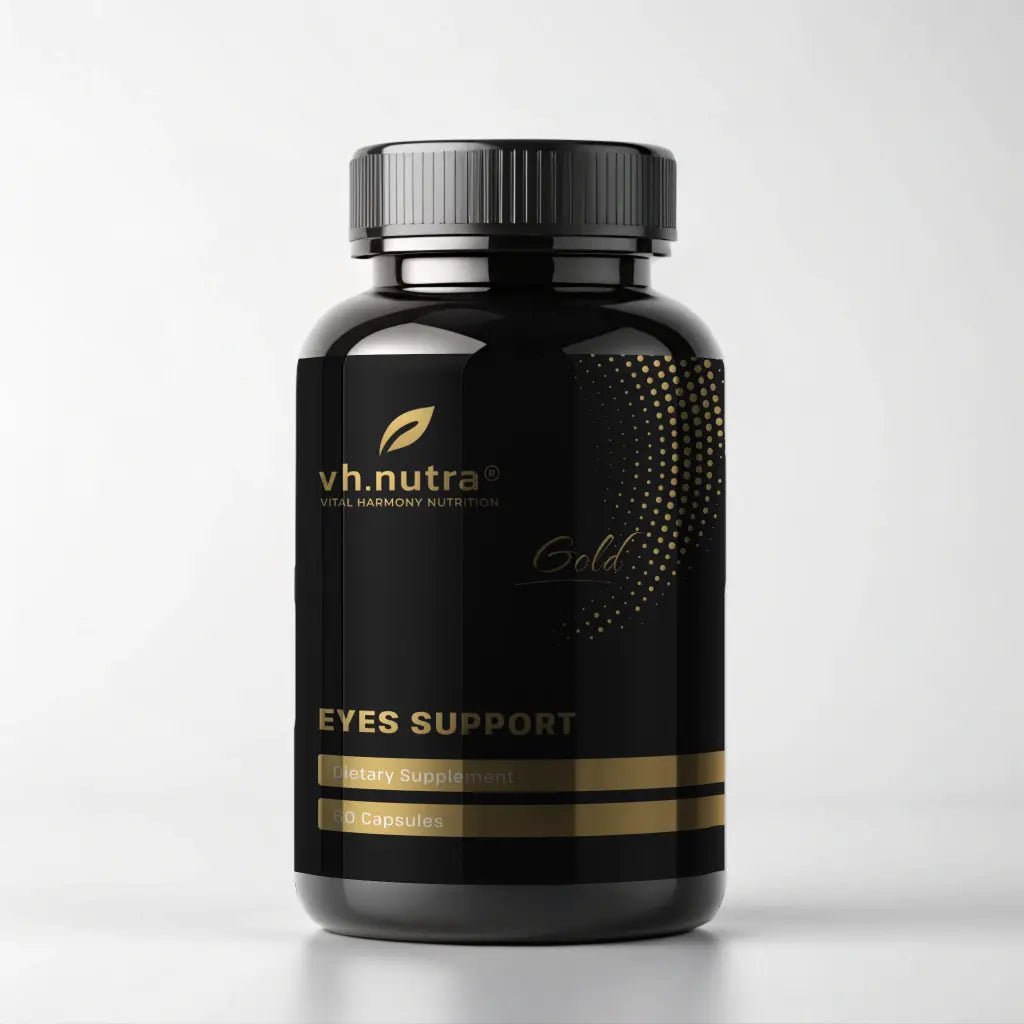
In practice this means that the two compounds work best together rather than separately. That is why most eye health supplements provide them in combination – for example, VH.Nutra Eyes Support combines marigold extract standardised to lutein and zeaxanthin with vitamins C, E, zinc and selenium.
Natural sources of zeaxanthin
Zeaxanthin is found mainly in yellow and orange foods, as well as in some dark green leafy vegetables. Interestingly, different sources provide it in different proportions with lutein.
The richest sources of zeaxanthin:
- Corn – one of the foods with the highest zeaxanthin content.
- Orange bell peppers – their bright orange colour signals a high concentration of zeaxanthin.
- Egg yolks – thanks to their fat, zeaxanthin is absorbed particularly well from them.
- Spinach and kale – they contain more lutein, but also some zeaxanthin.
- Goji berries and marigold flowers – natural concentrated sources.
Note: although marigold (Tagetes erecta) is the main industrial raw material for zeaxanthin supplements, there is no need to eat it – standardised supplements are made from extracts of these flowers. Vitamin A, the deficiency of which can impair vision in dim light, is also important for vision health.
How much zeaxanthin per day?
There is no official recommended daily amount of zeaxanthin – it is not considered an essential nutrient, so no separate amount has been established for it. Nevertheless, the doses used in scientific studies provide a practical reference point.
Around 2 mg of zeaxanthin per day is most commonly recommended, usually together with 10 mg of lutein – exactly the combination used in the AREDS2 study. A typical Western diet provides roughly 1–3 mg of lutein and zeaxanthin combined per day, so some people who eat few vegetables may not get enough.
For comparison: a single medium corn cob contains about 0.5–1 mg of zeaxanthin, and a serving of orange bell peppers has a similar amount. To get the doses used in studies from food alone, you would have to eat quite a lot of these products every day.
How to take zeaxanthin
Dose. Around 2 mg of zeaxanthin per day is most commonly recommended, often together with 10 mg of lutein. Always follow the amount stated on the specific product’s label, as different supplements may have different doses.
When to take it. Zeaxanthin can be taken at any time of day – the most important thing is regularity. In practice it is easiest to take it with a meal that contains fat, for example with breakfast or dinner.
With or without food. Since zeaxanthin is fat-soluble, it is best absorbed with food that contains fat – an egg, avocado, nuts or a spoonful of olive oil. Taken on an empty stomach, some of the compound may not be absorbed.
For how long. Macular pigment density increases slowly, so results should not be expected within a few days. In studies, a visible change usually appears after 3–6 months of consistent use.
Maximum safe dose. No official upper safe limit has been established for zeaxanthin. Higher doses (up to 20 mg per day) have been used safely in studies, but very large amounts can cause harmless yellowing of the skin. Follow the recommended dose and do not exceed the amount stated on the package.
Side effects and safety
Zeaxanthin is considered a well-tolerated compound, and serious side effects at recommended doses are practically unknown. Most people take it without any noticeable reactions.
The only well-documented phenomenon, occurring with very high carotenoid doses over a long time, is yellowing of the skin (carotenodermia). It is not dangerous and disappears once the dose is reduced, but it looks unusual, so it is best avoided.
There is little data on zeaxanthin use during pregnancy and breastfeeding and in children, so for these groups supplements should only be taken after consulting a doctor. If you have eye conditions or take medicines, it is also worth consulting a specialist before starting.
Zeaxanthin and drug interactions
No significant interactions of zeaxanthin with medicines have been identified so far, which sets it apart from some other carotenoids. For example, beta-carotene is linked to an increased risk of lung cancer in smokers, which is why it was replaced with lutein and zeaxanthin in the AREDS2 study.
Nevertheless, as with any supplement, if you take prescription medicines or have chronic conditions, consult a doctor or pharmacist before starting. This is especially important if you take blood thinners or other regular medicines.
Who should consider zeaxanthin supplements?
Zeaxanthin supplements are most often chosen by people who want to take extra care of their eye health in the long term. This is especially relevant for office workers who spend long hours in front of screens, drivers and anyone whose diet lacks fresh vegetables.
For older adults with a family history of macular degeneration, a supplement can be a sensible part of prevention – but the decision is always worth discussing with an eye doctor. Other compounds, such as astaxanthin, also support the eyes’ antioxidant protection.
If you decide to take a supplement, choose a comprehensive eye formula in which zeaxanthin is provided together with lutein and supporting antioxidants – for example, VH.Nutra Eyes Support combines marigold extract with vitamins C and E, zinc and selenium.
Frequently asked questions
How does zeaxanthin differ from lutein? Chemically they are isomers – they differ in the position of one double bond. In the retina lutein accumulates more at the edges, while zeaxanthin concentrates in the centre, where vision is sharpest. Both work together, so supplements usually provide them in combination.
When is the best time to take zeaxanthin? The time of day does not matter much; the most important thing is to take it regularly. Since it is fat-soluble, it is best taken with food that contains fat – for example, with breakfast or dinner.
Does zeaxanthin have side effects? At recommended doses side effects are very rare. When very large doses are taken over a long time, the skin may turn slightly yellow – this is harmless and disappears once the dose is reduced.
Is zeaxanthin suitable for children? Reliable studies on zeaxanthin use in children are lacking, so supplements should only be given to children after consulting a paediatrician. For children the most important thing is a varied diet with vegetables and eggs.
Does zeaxanthin help with eye strain from the computer? Zeaxanthin can help protect the retina from blue light, but it is not a direct treatment for eye strain. In front of screens the most important thing is to take breaks, blink and keep a proper distance from the monitor.
How do I choose a zeaxanthin supplement? Choose a product from a reputable manufacturer with a stated exact amount of zeaxanthin (usually around 2 mg). It is best when it is provided together with lutein, and ideally also with vitamins C, E, zinc and selenium.
Disclaimer: This information is for educational purposes only. Before taking supplements, consult a doctor or pharmacist.
Related articles
- Lutein: 7 benefits for eyes, vision and protection against blue light
- Astaxanthin: 7 benefits for skin, eyes and antioxidant protection
- Vitamin A: 7 benefits for vision, immunity and skin