Table of contents
In short:
- Chaga is a parasitic fungus that grows on birch trees in cold climates and has been used as tea for centuries.
- The value of chaga is linked to beta-glucans, triterpenoids and melanin – compounds that show immune and antioxidant effects in laboratory studies.
- Human clinical trials are still scarce, so most chaga benefits are considered preliminary rather than proven.
- Chaga is high in oxalates – people prone to kidney stones should be cautious.
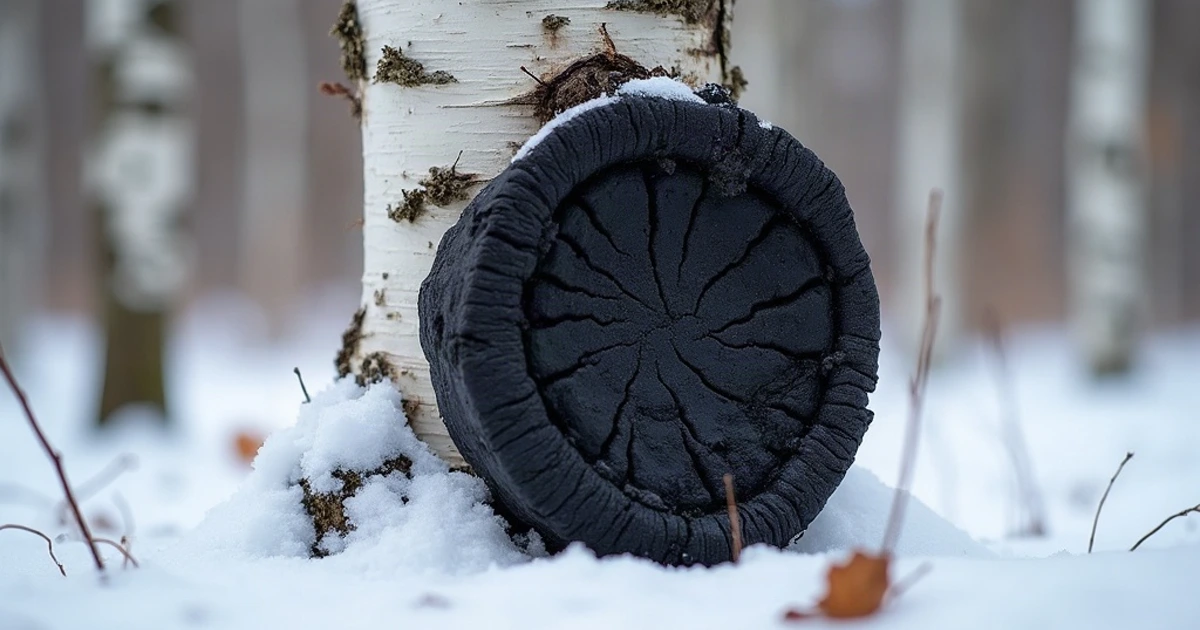
Chaga is a fungus that looks like a charred growth on a tree, and it was used for hundreds of years in Siberia, Russia and Scandinavia as a traditional tea for supporting health. Today it is increasingly found as an extract, powder or capsules, and its popularity is driven by the exceptionally high antioxidant value measured in the laboratory. In this article we review what chaga is, what benefits research suggests and how to take it safely.
Key takeaways
- Chaga is a birch mushroom valued for its beta-glucans, triterpenoids and melanin.
- Laboratory studies show antioxidant and immune-modulating effects, but human studies are few.
- Traditionally chaga is drunk as tea, and supplements most commonly provide 1–2 g of powder per day.
- Its high oxalate content calls for caution in people with kidney stones; consult a doctor before use.
What is chaga?
Chaga (Latin Inonotus obliquus) is a parasitic fungus that settles on living birch trees, and more rarely on alders or hornbeams. On the outside it looks like a black, deeply cracked lump resembling a piece of charcoal, while inside there is a golden or copper-coloured mass. It is this sterile, bark-like growth that is collected for medicinal purposes, because the actual fruiting body of the fungus appears only rarely.
Chaga grows in cold-climate regions – Siberia, Scandinavia, the Baltic countries, Russia, northern Canada and Alaska. Traditionally it was brewed as a strong tea, and local peoples used it to support digestion, general resilience and energy. Today chaga belongs to the group of medicinal mushrooms – the same group as reishi or lion’s mane, valued for their immune-supporting polysaccharides.
Traditionally chaga is harvested in winter or early spring, when the trees are bare and the fungus is easier to spot. The cut conk is dried and later ground – it is used to brew tea or to make extracts. Modern industry usually uses hot-water or dual-extraction methods to obtain both water-soluble and fat-soluble compounds. That is why a quality chaga extract usually states its polysaccharide or beta-glucan content on the label.
A large part of chaga’s chemical value comes not only from the fungus itself but also from the birch: it accumulates betulin and betulinic acid – substances found in birch bark. Together with the beta-glucans and melanin produced by the fungus itself, these compounds form the basis for most of the chaga properties studied today.
Chaga benefits for immunity
Chaga is most often linked to immune system support, and there is a basis for this: its beta-glucans are polysaccharides that interact with immune cells. In test-tube and animal studies, chaga extracts stimulated the activity of macrophages and other immune cells, helped the body respond to stimuli and supported the balance of natural defence-signalling molecules called cytokines.
It is important to stress that these data come mainly from laboratory studies, not from large human clinical trials. This means chaga may be a useful tool for everyday immune support, but it should not be regarded as a medicine against disease. For those seeking general seasonal support, chaga is often combined with other measures – for example, healthy eating and sleep habits, which together strengthen the body’s resilience.
Another advantage of chaga is its adaptability. Because it works by gently modulating rather than strongly stimulating, it is often chosen as a longer-term supplement in the cold season. However, for people with autoimmune conditions this property may be a risk rather than a benefit – more on this in the side-effects section.
Antioxidant protection and inflammation
Chaga stands out for its exceptionally high antioxidant value, measured on the ORAC scale – one way to compare how effectively a substance neutralises free radicals. This ability is mainly linked to melanin, which gives chaga its black colour, as well as polyphenols and other plant compounds.
Free radicals are unstable molecules that can damage cells when too many of them are produced – a process called oxidative stress. Antioxidants help reduce this stress. In test-tube studies, chaga extracts showed a strong ability to bind free radicals, which is one of its best-supported properties.
Inflammation is closely linked to oxidative stress. Preliminary studies show that chaga compounds may inhibit the production of certain inflammatory signals, but these results come mostly from cell cultures. For this reason, authoritative sources currently assess chaga’s anti-inflammatory effect in humans cautiously – as promising but not yet proven.
In practice this means that people choose chaga tea or extract not only for the taste but also to get an extra portion of plant antioxidants. However, antioxidant value measured in a test tube does not always translate directly into an effect in the body – some compounds may be poorly absorbed during digestion. Therefore chaga is best seen as part of a healthy routine rather than as the only source of antioxidants.
Other properties of chaga under study
Besides immunity and antioxidant protection, chaga is also attributed other properties that are currently being studied:
- Sugar metabolism. Small studies suggest chaga could affect blood glucose levels, but there is too little data for reliable conclusions.
- Cholesterol metabolism. In animal studies chaga extracts are linked to changes in the lipid profile, but human confirmation is lacking.
- Digestion. Traditionally chaga tea was used to ease stomach discomfort; the mechanisms are still being explained.
All of these directions are at an early stage. If any chaga producer promises a specific therapeutic effect – for example, treating cancer or diabetes – such claims deserve scepticism: science does not yet have that level of evidence, and the fungus itself is a food supplement, not a medicine.
How to take chaga?
There is no officially approved daily dose of chaga, so recommendations are mostly based on traditional use and supplement labels. The most common options are:
- Tea. The traditional method: 1–2 cups per day. A spoonful of dried chaga is simmered over low heat for 20–40 minutes until the water turns dark brown.
- Powder. Usually 1–2 g per day, mixed into a drink, porridge or smoothie.
- Extracts and capsules. The dose depends on the concentration – usually 500–1000 mg per day; always follow the amount stated on the package.
When to take it? Chaga contains no caffeine and has no stimulating effect, so it can be drunk both in the morning and in the evening. Many people choose tea in the morning or after lunch. If chaga is drunk as a coffee substitute, an evening cup usually does not disturb sleep.
For how long? Chaga is usually taken in cycles – for example, 2–3 months in the cold season, followed by a break. The maximum safe dose is not clearly established, so it is best not to exceed the amount stated on the package and, when taking it for longer than a few weeks, to consult a doctor or pharmacist.
How soon will you notice an effect? Unlike stimulating substances, chaga works gradually, so most people do not notice a sudden change. Traditionally it is taken over a longer period – weeks or months – for general support. If after a few weeks you feel well, you can continue with the chosen routine, and if unusual symptoms appear, stop and consult a specialist.
Side effects and safety
Chaga is generally considered well tolerated when taken for a short time at usual doses. However, there are a few important warnings:
- Kidney stones. Chaga contains a lot of oxalates – compounds that may contribute to the formation of calcium oxalate kidney stones. People who have had kidney stones or have kidney problems should avoid chaga.
- Autoimmune conditions. Because chaga may affect the immune system, people with multiple sclerosis, rheumatoid arthritis or lupus should only take it after consulting a doctor.
- Pregnancy and breastfeeding. Reliable data are lacking, so chaga is best avoided during these periods.
Chaga interactions with medicines
Chaga may interact with certain medicines, although most of these interactions are based on theoretical mechanisms rather than clinical observations:
- Blood-sugar-lowering medicines. Chaga could theoretically strengthen their effect and cause hypoglycaemia. If you take diabetes medication, monitor your glucose level and consult a doctor.
- Blood-thinning medicines. Some studies suggest chaga may affect clotting, so people taking anticoagulants or antiplatelet medicines should be cautious.
- Other supplements. When combining chaga with other immune-affecting preparations, it is worth starting with a lower dose and monitoring how you feel.
If you take any regular medicines, consult a doctor or pharmacist before adding chaga to your routine – it is a simple but important precaution.
How to choose a chaga supplement?
The chaga supplement market is broad and quality varies. When choosing, pay attention to a few things:
- Extract type. Prefer water or dual (water and alcohol) extract products – these methods draw out beta-glucans and triterpenoids.
- Standardisation. Quality products state the amount of active compounds, such as the percentage of polysaccharides or beta-glucans.
- Origin. Wild chaga harvested from birch trees is valued more than artificially cultivated chaga grown on other trees, because birch provides the betulin compounds.
Should you choose tea or an extract? Tea suits those who enjoy the brewing ritual and the mild taste, while capsules or powder suit when convenience and a more precise dose matter. Both forms deliver useful compounds, but extracts are often more concentrated. If you are unsure, start with the simpler form and monitor how you feel.
If you are interested in a wider range of medicinal mushrooms, it is worth looking at other supplements in this group – for example, lion’s mane extract, traditionally linked to brain and nervous system support. You can also combine mushroom supplements with vitamin C – it contributes to the normal functioning of the immune system.
Frequently asked questions
Does chaga contain caffeine?
No, chaga does not contain caffeine. Although its tea resembles coffee in its dark colour and mild taste, it does not stimulate the nervous system at all and can be drunk in the evening.
What are the benefits of chaga tea?
Chaga tea is the traditional way of using this fungus. It provides beta-glucans, melanin and polyphenols – compounds linked to antioxidant protection and immune system support. A longer brewing time is needed, because hot water helps extract the polysaccharides.
Does chaga help you lose weight?
There is no reliable evidence that chaga promotes weight loss. It is not a fat burner and should not be chosen for this purpose.
What does chaga tea taste like?
Chaga tea has a mild, slightly earthy and vanilla-like taste, without a strong mushroom bitterness. Many people like it even without added sweeteners.
Disclaimer: This information is for educational purposes only. Consult a doctor or pharmacist before starting to take supplements.
Related articles
- Reishi mushroom: benefits for immunity, sleep and calm
- Cordyceps: benefits for energy, endurance and how to take it
- Lion’s mane: benefits for the brain and focus