Table of Contents
In short:
- Vitamin K2 is a lesser-known but extremely important vitamin responsible for directing calcium where it is needed – to bones and teeth, not to blood vessels.
- The MK-7 form is the most effective – it remains in the body for up to 72 hours, thus ensuring a stable level of vitamin K2 in the blood.
- Synergy with vitamin D3 – these two vitamins work as a pair: D3 helps absorb calcium, while K2 directs it to bones, protecting blood vessels from calcification.
- Vitamin K2 deficiency is common in the modern diet – sufficient amounts are only obtained by consuming fermented products or supplements.
1. Bone Mineralization and Osteoporosis Prevention
Vitamin K2 plays an essential role in bone health – it activates the protein osteocalcin, which helps bind calcium in the bone matrix. Without sufficient K2, osteocalcin remains inactive, and calcium, instead of being deposited in bones, can accumulate in soft tissues and blood vessels.
Studies conducted in Japan have shown that higher intake of vitamin K2 (especially the MK-7 form found in the traditional Japanese dish natto) is associated with a significantly lower risk of hip fractures. In postmenopausal women, vitamin K2 supplements helped slow bone density loss and reduce the likelihood of osteoporotic fractures by up to 60–80%.
Unlike calcium supplements, which without K2 can increase the risk of vascular calcification, vitamin K2 ensures that calcium goes exactly where it is needed. This is especially important for older people and women during menopause, when bone thinning becomes a serious health problem.
2. Heart and Cardiovascular Protection
One of the most important functions of vitamin K2 is the activation of the protein MGP (Matrix Gla Protein). This protein is the most powerful natural inhibitor of vascular calcification in the body. When MGP is activated by vitamin K2, it prevents calcium from accumulating in the artery walls, thus protecting against atherosclerosis.
The famous Rotterdam Study, which involved over 4,800 participants followed for 7–10 years, revealed impressive results: people who consumed the most vitamin K2 had a 57% lower risk of dying from heart disease and a 52% lower risk of aortic calcification compared to those who consumed the least. Meanwhile, vitamin K1 did not show such a protective effect.
This means that vitamin K2 is one of the most effective natural ways to protect the cardiovascular system, especially in older age when arterial calcification becomes a major cause of heart disease.
3. Dental Health – Remineralization and Protection Against Cavities
Vitamin K2 also plays an important role in dental health. Together with vitamin D3, it helps activate proteins responsible for the remineralization of tooth dentin. Dentin is the tissue beneath tooth enamel, and new research shows it can be restored by the action of specific proteins activated by vitamin K2.
The legendary dentist Weston A. Price observed as early as the early 20th century that in traditional communities whose diets were rich in fat-soluble vitamins (including K2), tooth decay was extremely rare, even in the absence of modern dental care. He called this mysterious factor “Activator X”, which was later identified as vitamin K2.
Modern studies confirm that adequate K2 levels help reduce the risk of tooth decay and maintain overall oral health by directing calcium to teeth where natural remineralization occurs.
4. Blood Clotting Regulation
Although blood clotting is primarily associated with vitamin K1, vitamin K2 also contributes to maintaining healthy clotting, but acts more gently and for longer. Vitamin K is required for the synthesis of clotting factors in the liver, and while K1 does this faster, K2 provides long-term support.
It is important to emphasize that vitamin K2 does not cause excessive blood clotting – it only helps maintain normal clotting function. Unlike some other supplements, K2 does not act as a blood thinner but regulates clotting so that it is balanced – neither too weak nor too strong.
This is especially important for people whose clotting function is impaired for various reasons, but consultation with a doctor is necessary when taking blood-thinning medications.
5. Improving Insulin Sensitivity
More and more studies show that vitamin K2 can have a positive effect on glucose metabolism and insulin sensitivity. The mechanism is related to the activation of osteocalcin – active osteocalcin affects not only bones but also the pancreas, stimulating insulin production and improving the cells’ response to insulin.
One study showed that men who took vitamin K2 supplements for 4 weeks had significantly improved insulin sensitivity compared to a placebo. Another large-scale study revealed that higher vitamin K2 intake was associated with up to a 20% lower risk of developing type 2 diabetes.
Therefore, vitamin K2 can be a valuable supplement not only for bone and heart health but also for metabolic health, especially for people with a tendency towards insulin resistance or prediabetes.
6. Reducing Inflammation in the Body
Chronic low-grade inflammation is the basis of many modern diseases – from heart disease to diabetes and autoimmune disorders. Vitamin K2 possesses anti-inflammatory properties that work through several mechanisms.
Studies show that vitamin K2 can inhibit the NF-κB signaling pathway – the main regulator of inflammatory processes in cells. It has also been observed that K2 reduces the production of inflammatory cytokines such as IL-6 and TNF-α. A 2019 study showed that K2 supplements significantly reduced levels of C-reactive protein (CRP) – one of the most important markers of inflammation – in the blood.
This anti-inflammatory effect may be one of the mechanisms explaining why K2 is associated with a lower risk of chronic diseases and better overall health status in older age.
7. Vitamin K2 and D3 Synergy – Why Do They Work Together?
Vitamin K2 and vitamin D3 are called the “perfect pair” in the supplement world, and for good reason. Their interaction is one of the most beautiful examples of synergy in human biochemistry. Vitamin D3 increases calcium absorption from the intestines into the blood, while vitamin K2 ensures that this calcium goes where it is needed – to bones and teeth.
Without vitamin K2, vitamin D3 can indirectly increase the risk of vascular calcification, because the increased calcium level in the blood lacks a “directing mechanism.” Studies confirm that the D3 and K2 combination is significantly more effective at increasing bone density than D3 alone, while simultaneously protecting blood vessels.
It is recommended to take vitamin D3 and K2 together, preferably with a meal containing fat – both of these vitamins are fat-soluble, so fats significantly improve their absorption. The optimal combination: 1000–4000 IU of D3 and 45–100 μg of K2 (MK-7) per day.
How to Choose Vitamin K2?
When choosing a vitamin K2 supplement, it is important to pay attention to the form and quality:
- The MK-7 form is the most effective – it remains in the body for up to 72 hours, so taking it once a day is sufficient. The MK-4 form only lasts 4–6 hours.
- Look for a K2 + D3 combination – these two vitamins work perfectly together.
- Choose naturally sourced MK-7, derived from natto (fermented soybeans), rather than synthetic.
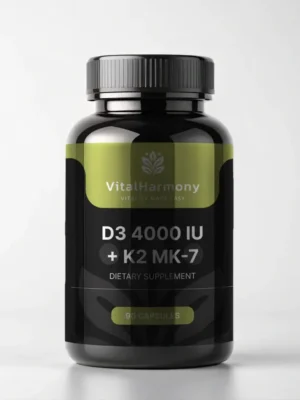
In the StayStrong range, you will find several excellent options: VitalHarmony VH.Nutra Vitamin K2 MK-7 50 μg for pure K2 support and VitalHarmony Vitamin D3 4000 IU + K2 MK-7 – an excellent combined choice for those who want to supply the body with both synergistically acting vitamins in one go.
Conclusion: Vitamin K2 is one of the most undervalued vitamins in the modern diet. Its benefits include not only strengthening bones and teeth but also heart protection, improving metabolism, and reducing systemic inflammation. Together with vitamin D3, it forms a powerful health support duo recommended by more and more health professionals.