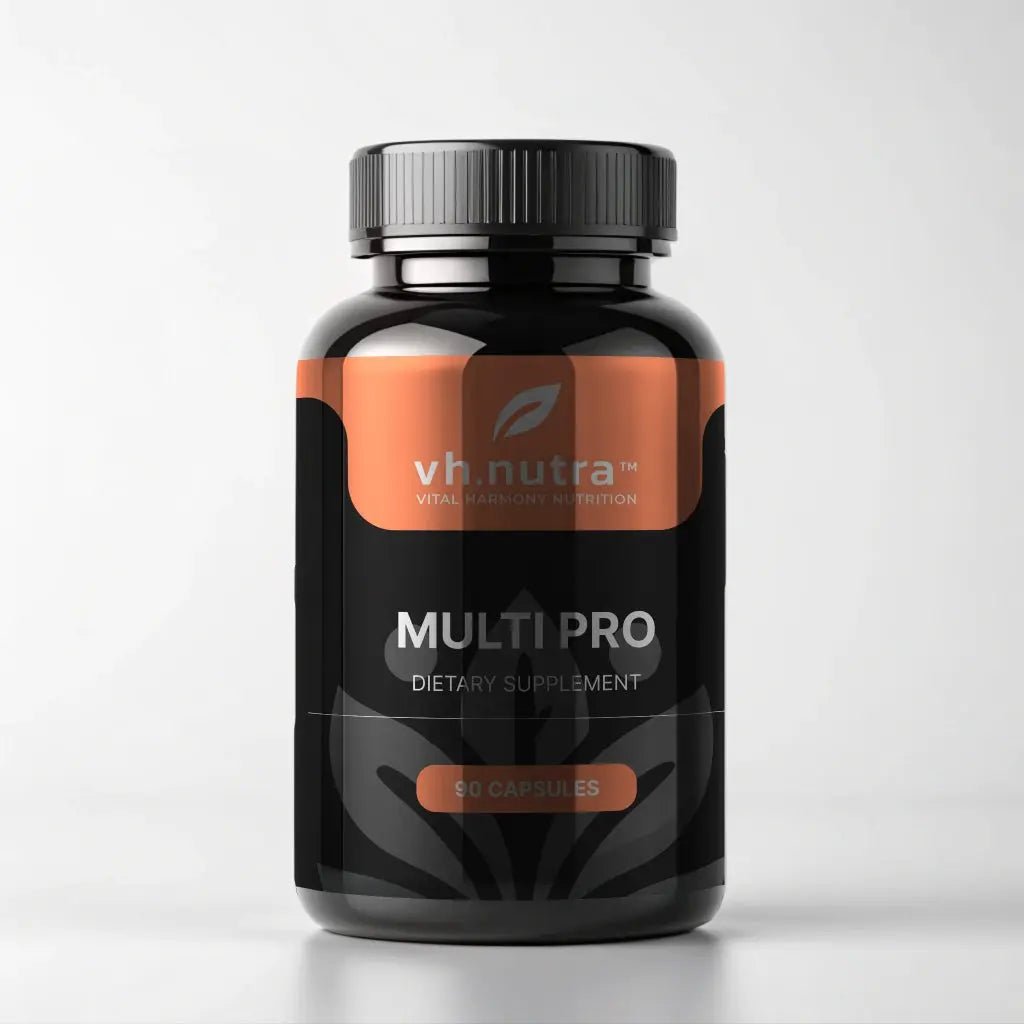
Multivitamins are combinations of vitamins and minerals in one product, designed to give your body all the most important nutrients every day. Even when trying to eat a varied diet, modern nutrition often lacks one or another micronutrient, and a multivitamin complex helps fill these gaps simply and conveniently.
Key Takeaways
- Multivitamins are vitamin and mineral complexes that help fill daily dietary gaps and support overall well-being.
- Main benefits – immunity, energy, skin, hair, bones, nervous system and heart – one capsule combines many functions.
- Quality matters – choose a complex with well-absorbed forms and appropriate doses, not the highest number of ingredients.
Table of Contents
What Are Multivitamins?
Multivitamins are dietary supplements that combine several vitamins and minerals in one capsule or tablet. Unlike single supplements that provide only one substance, a multivitamin complex supplies the body with a broad spectrum of micronutrients needed for daily functions – from energy production to the work of the immune system.
A classic multivitamin formula usually contains vitamin C, vitamin D, B vitamins, vitamin E, zinc, magnesium, iron and other minerals. Each of these ingredients plays its own role, and together they work synergistically – some help others to be absorbed and perform their function better.
It is important to understand that multivitamins are not a food replacement, but a safety net. They are designed for times when the diet is not perfect – for example, during periods of intense work, sports, stress or restrictive diets. Read more about the scientifically backed properties of multivitamins in the U.S. National Institutes of Health review.
1. Strengthens Immunity
Strong immunity depends on many vitamins and minerals, and multivitamins supply them all at once. Vitamin C supports the work of immune cells and protects them from oxidative damage, zinc is essential for the production of immune cells, and vitamin D regulates the immune response. A shortage of any of these substances weakens the body’s defense against infections.
Research shows that people who regularly take multivitamin complexes are more likely to maintain the recommended micronutrient levels in their body – and this is especially important in the cold season, when the body’s needs increase. A steady, rather than erratic, supply of vitamins helps the immune system work consistently.
🛒 VH.Nutra Multi Pro — 8,59 € – a premium multivitamin and mineral complex where vitamin C, D3, zinc and magnesium are combined in one formula. Read more about the effect of vitamin C on immunity in our article on vitamin C.
2. Reduces Fatigue and Adds Energy
Constant fatigue is often not a sign of lack of sleep, but of a micronutrient deficiency. B vitamins – especially B12, B6 and folic acid – are directly involved in energy production, helping the body convert food into usable energy. Iron ensures oxygen transport, while magnesium takes part in more than 300 enzymatic reactions.
When these substances are lacking, the body simply cannot produce energy efficiently enough – you feel tired even after full rest. Multivitamins help replenish these reserves and return energy levels to a normal rhythm without caffeine or other stimulants.
B vitamins are the most important in this process, so it is worth choosing a complex that contains enough of them. 🛒 VH.Nutra B Complex — 3,76 € – a B vitamin complex that complements multivitamins with a targeted dose for energy and reduced fatigue. Read more about these vitamins in the article on B vitamins.
3. Supports Skin, Hair and Nails
The condition of your skin, hair and nails directly reflects the inner state of your body. Vitamin C is essential for the production of collagen – the protein that gives skin firmness and elasticity. Biotin and B vitamins strengthen hair and nails, while vitamin E, as an antioxidant, protects skin cells from damage caused by free radicals.
Zinc takes part in skin cell renewal and wound healing, so its deficiency often shows up as slow-healing wounds or deteriorating skin condition. When you take multivitamins regularly, these substances reach the skin steadily rather than in bursts – and it is this consistency that produces visible results.
Of course, supplements alone will not replace proper care and nutrition, but they create a solid foundation for healthy skin, strong hair and nails. Read more about the benefits of zinc for the skin in the article on zinc.
4. Strengthens Bones and Teeth
Bone strength depends not only on calcium – it requires a whole combination of micronutrients. Vitamin D helps the body absorb calcium from food, vitamin K2 directs calcium into the bones, and magnesium takes part in bone tissue formation. Without these supporting substances, calcium simply will not reach the bones and teeth.
A quality multivitamin complex supplies all these components at once, so bones receive not only building material but also the tools to use it. This is especially important in older age, when bone density naturally declines, as well as for active athletes whose bones are under greater load.
For maximum benefit, it is worth checking that the complex contains enough vitamin D – many people lack it, especially in the cold season. Read more about the importance of this vitamin in the article on vitamin D.
5. Supports the Nervous System and Focus
The nervous system is one of the most energy-demanding systems in the body, so it is very sensitive to micronutrient deficiencies. B vitamins are essential for transmitting nerve impulses, magnesium helps the nervous system relax, and vitamin B12 takes part in forming the protective sheaths of nerve fibers.
A shortage of these substances can show up as irritability, poor concentration, memory decline or even tingling in the hands and feet. Multivitamins help maintain a steady level of these substances, so the brain gets everything it needs to sustain attention and clear thinking.
This matters not only for students or office workers, but for everyone who wants to stay alert during the day. Regular supplementation gives a more even result than occasional “energy” products, which act briefly and can cause fluctuations.
6. Supports Heart and Blood Vessel Health
For the heart and blood vessels, it is not one but several micronutrients that matter, and multivitamins supply them together. Magnesium helps maintain a normal heart rhythm, vitamins B6, B12 and folic acid take part in homocysteine metabolism, and vitamins C and E, as antioxidants, protect blood vessel walls from damage.
Homocysteine is an amino acid whose excessive levels are linked to a higher risk of heart and blood vessel disease. B vitamins help the body convert homocysteine into harmless substances, so their sufficient amount is an important factor for heart health.
Of course, supplements alone will not replace a healthy lifestyle – physical activity and a balanced diet. But multivitamins are a simple way to make sure the heart gets the micronutrients it needs every day, especially when the diet is not ideal.
7. Fills Dietary Gaps
This is the most common reason people start taking multivitamins at all. Modern nutrition – fast food, processed products, restrictive diets – often fails to provide the body with all the necessary substances. Multivitamins act as a safety net that covers these gaps.
Particularly vulnerable groups are vegans and vegetarians (who often lack B12, iron and zinc), pregnant women, older people and those who train intensely. For these groups, a multivitamin complex can be not a luxury but a necessity for maintaining health.
It is important to choose a complex that fits your lifestyle – for example, women benefit from a formula with more iron, while men benefit from one with zinc. 🛒 VH.Nutra Multi Pro – a balanced choice whose formula is designed for daily use and covers the most important vitamins and minerals.
How to Take Multivitamins?
Recommended dose: Most multivitamins are taken as 1 capsule or tablet per day. Always follow the manufacturer’s instructions on the package – some complexes are taken as 2 capsules, split over the day.
When to take: It is best to take multivitamins in the morning, with breakfast or right after it. Food improves the absorption of fat-soluble vitamins (A, D, E, K) and reduces the risk of stomach irritation. Avoid taking them in the evening, as B vitamins can provide energy and make it harder to fall asleep.
Duration of use: Multivitamins can be taken continuously, because their purpose is to maintain a steady micronutrient level. Still, it is sensible to periodically reassess whether you still need them – for example, after blood tests that show specific deficiencies.
Maximum safe dose: Do not exceed the dose stated on the package. Be especially careful with fat-soluble vitamins (A, D, E, K), which accumulate in the body – their excess can be harmful, unlike water-soluble B and C vitamins, whose excess is excreted in urine.
Possible Side Effects
Multivitamins are generally well tolerated, especially when taken with food. The most common side effect is mild stomach discomfort or nausea, which occurs when supplements are taken on an empty stomach. These symptoms are easy to avoid simply by taking multivitamins with a meal.
Some people may notice bright yellow urine – this is a completely normal phenomenon related to the excretion of excess water-soluble vitamin B2 (riboflavin) and causes no harm. Complexes containing iron may cause constipation, so sensitive people should choose a formula without iron or with a gentler form of it.
People taking medication, especially blood thinners, should consult a doctor before starting multivitamins, because vitamin K can interact with some medicines. The same applies to pregnant and breastfeeding women.
Multivitamins and a Healthy Diet — What to Know?
Multivitamins will never replace a wholesome diet. Whole food contains fiber, antioxidants and other beneficial compounds that no supplement can replace. Multivitamins are a supplement, not a substitute – they are meant to fill gaps, not to replace vegetables, fruit and complete proteins.
The best strategy is to fix your diet first and use supplements as a safety net. If your diet is already varied and wholesome, the need for multivitamins may be smaller. But in real life, few people eat enough varied food every day, so a quality complex is a sensible daily measure for many.
It is also worth combining different supplements according to your needs – for example, zinc and vitamin C will strengthen immune support, while vitamin D supports bones and mood. Such a combination creates a solid foundation for overall well-being.
Frequently Asked Questions
Are multivitamins really necessary if I eat healthy?
If your diet is truly varied and wholesome, the need for multivitamins may be smaller. However, in practice many people do not get all the necessary nutrients, so a quality complex acts as a safety net – it ensures the body lacks nothing.
When is the best time to take multivitamins?
Best in the morning, with breakfast. Food improves the absorption of fat-soluble vitamins and reduces the risk of stomach discomfort. Taking them in the evening is not recommended, as B vitamins can provide energy and interfere with sleep.
Can multivitamins replace a healthy diet?
No. Multivitamins are a supplement, not a replacement. Whole food contains fiber and other beneficial compounds that no supplement can replace. Multivitamins are meant to fill gaps, not to replace vegetables and fruit.
What vitamins and minerals should a good complex contain?
A good complex should include vitamin C, D, B vitamins, zinc, magnesium and, depending on need, iron or calcium. What matters is not the number of ingredients, but their forms and doses – choose well-absorbed forms and not overloaded doses.
Can I take multivitamins with other supplements?
Usually yes, but it is important to watch the total doses so you do not exceed recommended amounts. For example, if you already take a separate vitamin D supplement, check how much is in your multivitamin and adjust the amounts.
How to choose quality multivitamins?
Look at the forms and doses of ingredients, not just their number. Choose a trusted manufacturer, a transparent label with exact amounts, and a form that is convenient for you to take daily. A good start is a complex suited to your gender and lifestyle.
Disclaimer: This information is for educational purposes only and cannot replace professional medical advice. Before taking any dietary supplements, be sure to consult a doctor or pharmacist.
Related Articles
- Vitamin C: 7 Benefits for Immunity, Skin and Energy
- Vitamin D: 7 Benefits for Immunity, Bones and Mood
- B Vitamins: 7 Benefits for Energy, Nervous System and Health