If it’s hard to “turn off your brain” in the evening and you feel irritable during the day, the problem isn’t always just stress or too little rest. Sometimes it’s worth looking deeper – at what your body actually uses to produce substances important for mood and sleep. One of these is serotonin, and one of its links is L-tryptophan.
The name of this amino acid is often mentioned in discussions about sleep, relaxation, and emotional well-being. However, reality isn’t as simple as “take it and feel good.” L-tryptophan can be an important piece of the puzzle, but its effect depends on the entire context – your diet, stress levels, other nutrients, sleep schedule, and even how your digestion works.
How L-tryptophan is related to serotonin
L-tryptophan is an essential amino acid. This means the body cannot produce it on its own – it must be obtained from food or supplements. The body uses L-tryptophan to produce 5-HTP, and from that, serotonin. Later, some serotonin can be used to produce melatonin, which is important for the sleep-wake cycle.
Therefore, the connection is simple: if there is a shortage of raw material, it’s harder for the body to maintain the optimal process. But here’s the nuance. Getting enough L-tryptophan alone is not sufficient. Other factors are also important for this chain – vitamin B6, magnesium, total protein intake, carbohydrate balance, and the load on the nervous system.
When people search online for the phrase “L-Tryptophan serotonin production,” they usually actually want an answer to one question: can it help them feel calmer, sleep better, and have a more stable mood? The answer is sometimes yes, but only when you hit the real cause.
What serotonin does for your well-being
Serotonin is often called the “happy hormone,” although technically it’s a neurotransmitter. This description is simplified, but the direction is correct – serotonin is linked to emotional balance, calmness, appetite, sleep, and even certain cognitive processes.
When these systems aren’t working optimally, you might experience irritability, emotional swings, difficulty falling asleep, stronger cravings for carbohydrates or sweets, and trouble relaxing in the evening. Of course, none of these symptoms alone prove a serotonin problem. Magnesium deficiency, general overwork, chronic stress, or poor diet can manifest similarly. If this topic resonates with you, it’s worth reading about supplements for stress and anxiety: what really works?.
Why L-tryptophan alone is sometimes not enough
This is often where disappointment begins. A person reads that tryptophan is linked to serotonin, starts taking a supplement, and sees little change. This happens because there isn’t a single button in the body that turns on a good mood.
First, L-tryptophan competes with other amino acids to get where it’s needed. Second, its conversion to serotonin requires cofactors. Third, if you live in a constant state of stress, sleep too little, and eat irregularly, a supplement alone rarely compensates for the overall load.
Another important point is that not everyone actually gets too little tryptophan. Sometimes the problem isn’t a deficiency, but an irregular schedule, too low calorie intake, too strict a diet, or poor overall sleep hygiene. Therefore, a sensible approach is not to look for a miracle, but to build a foundation.
From which foods is L-tryptophan obtained
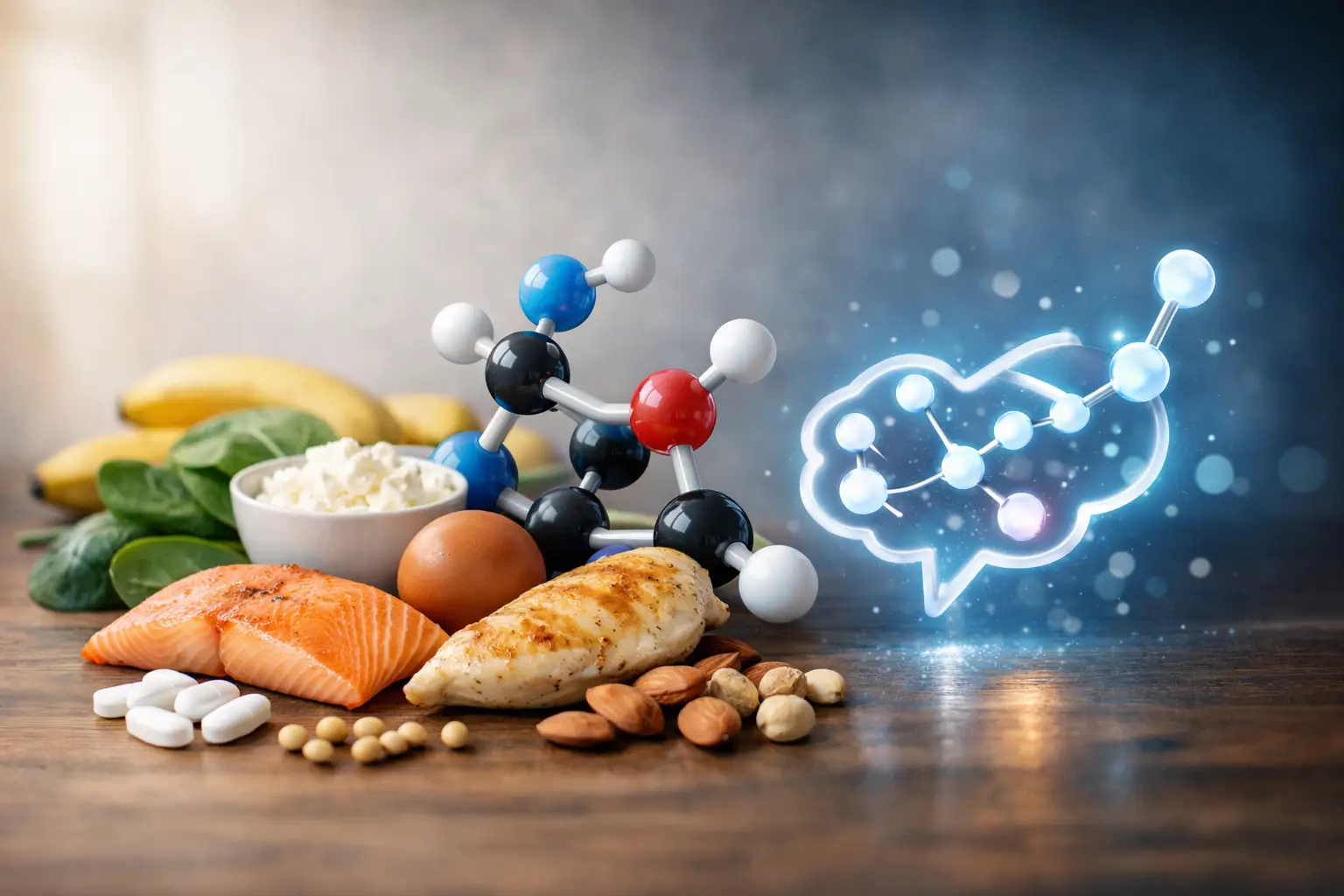
Since it’s an amino acid, you’ll naturally find it in protein-rich foods. L-tryptophan is found in eggs, dairy products, meat, fish, legumes, seeds, and nuts. If your diet is consistently low in protein, theoretically, the chance of getting enough tryptophan also decreases.
Here it’s worth remembering a basic point – if you’re still not sure whether you’re getting enough protein overall, start there. We wrote more about this in the article How much protein do you need per day?.
In practice, it’s often not just “more protein” that works best, but balanced eating throughout the day. Some people feel calmer in the evening if their dinner includes not only protein but also a moderate amount of carbohydrates. This can improve the availability of tryptophan for certain processes. This doesn’t mean you should overeat or eat anything in the evenings. The point is not extremes, but a smart combination.
When might an L-tryptophan supplement be considered
A supplement can be useful when you see a clear context: a lot of stress, a tense evening, difficulty relaxing, shallow sleep, less-than-ideal diet, or due to your schedule you can’t always get what you need from food. In such a case, L-tryptophan can be one of the tools, not the sole solution.
Most people consider it for three reasons – emotional tension, sleep quality, and that evening “wired” feeling when the body is tired but the brain is still racing. In these situations, it’s important to look at the whole picture. If you drink a lot of caffeine in the evening, work late, constantly scroll on your phone, and expect one capsule to fix everything, the result may be disappointing.
Sometimes a whole routine works better than a single ingredient. If your goal is better rest, it’s useful to look into sleep supplements: what to choose for better sleep.
What else is important for serotonin production
L-tryptophan is the beginning, but not the whole story. For serotonin production to run more smoothly, several other elements are also important.
Vitamin B6 is involved in amino acid metabolism and nervous system function. Magnesium is linked to nervous system balance, relaxation, and sleep quality. If these substances are lacking, well-being can worsen even when you get enough protein. This is precisely why people sometimes look for tryptophan when they actually have a greater deficiency in basic things. It’s worth reading about this in the article “Magnesium”: when you really lack it and what to do.
Overall energy balance is also important. If you follow a very low-calorie diet for a long time, eat too little, or severely restrict carbohydrates, you may feel more irritable, sleep poorly, and recover less well. In such a case, the problem isn’t necessarily just in the serotonin chain. Sometimes the body is simply running in “economy mode” for too long.
Does more always mean better
No. A common mistake with supplements is thinking that a higher dose will necessarily provide a stronger effect. Neither sleep nor the nervous system works that way. In some cases, a larger amount can cause unwanted sensations without any real additional benefit.
It’s also important that L-tryptophan supplements are not suitable for everyone. Particular caution is needed if you are taking medications related to serotonin metabolism or the nervous system. In such cases, you should not experiment on your own – you must first consult a doctor or pharmacist.
It’s also worth remembering that long-term poor sleep, mood disorders, or severe anxiety are not just a matter of supplements. If symptoms are pronounced or persistent, a broader evaluation is needed.
How to understand if you should start with the basics, not with a supplement
If you want real progress, start with a few simple questions. Do you eat enough protein? Do you consume too much caffeine in the evening? Does your sleep have at least an approximate rhythm? Are you lacking magnesium, B vitamins, or overall rest? Is the high fatigue related to other causes?
For some people, these adjustments alone give more than a single supplement. If you feel constantly exhausted, it’s first worth understanding what is truly “draining” you. An article can also help here: Why do you constantly feel tired? 10 common reasons.
Once the foundation is in order, targeted solutions start working much better. It is precisely this approach that usually yields the most stable result—not an impulsive attempt to solve everything with one product, but a consistent strengthening of well-being.
What is worth remembering about the topic of L-Tryptophan and serotonin production
The connection between L-tryptophan and serotonin is real. It is not a myth or a marketing trick. However, it is neither linear nor automatic. L-tryptophan is a raw material, not a guarantee. If your body lacks other links or your life rhythm constantly disrupts the nervous system’s balance, this single amino acid may not be enough.
If you approach this topic wisely, you can gain a lot. First, assess your diet, sleep, stress, and overall routine. Then, consider whether targeted supplementation could be a helpful aid in your daily journey toward better well-being. A stronger tomorrow often begins not with a miracle, but with a few correct steps today.