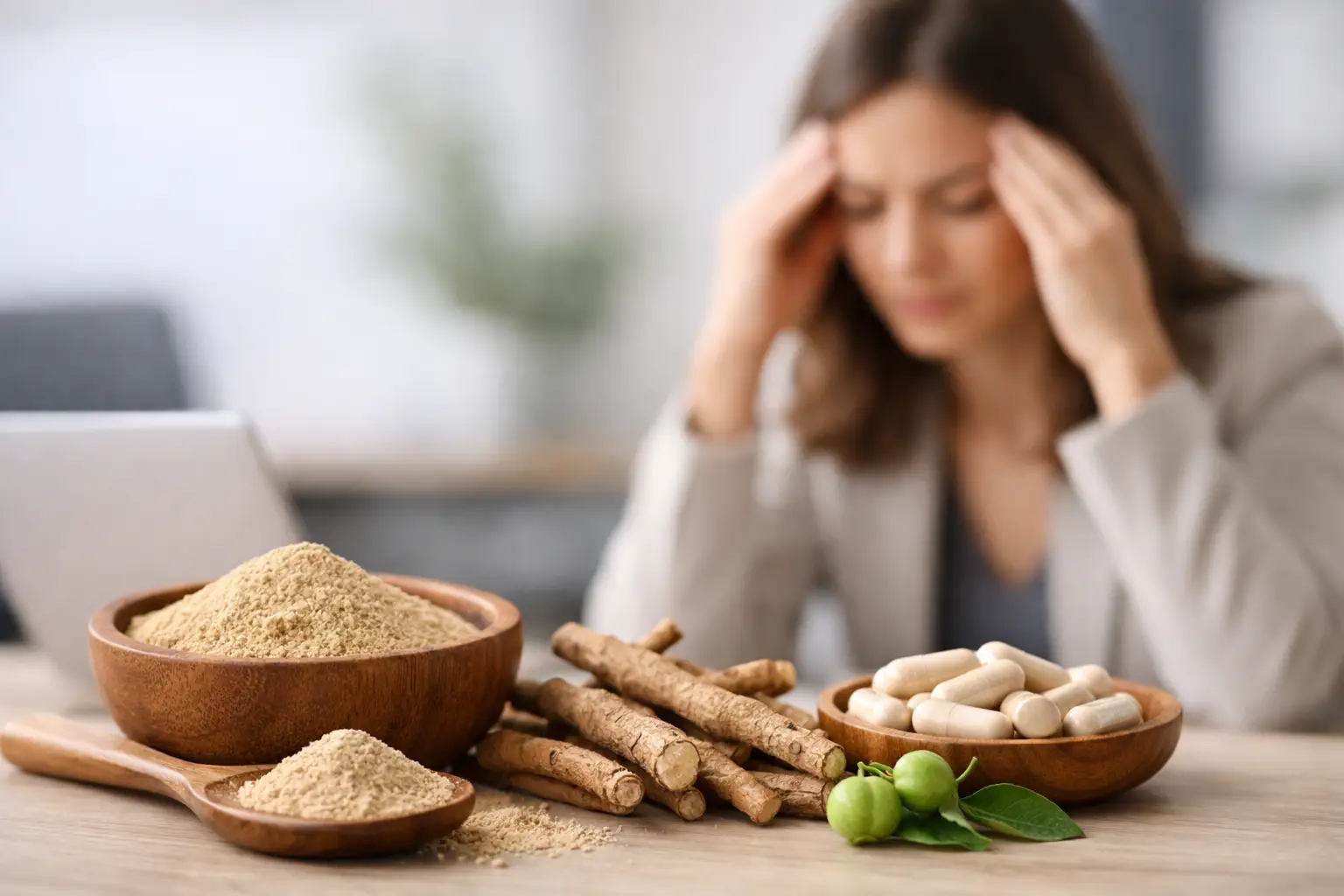
When tension doesn’t last just one day but weeks, motivation alone often stops helping. At that point, the question of how to use ashwagandha for stress becomes very practical — you want not theory, but a clear answer: when, how much, and what to realistically expect.
Ashwagandha is often mentioned among adaptogens — plant-based substances linked to the body’s adaptation to stress. Still, what matters most isn’t just the ingredient itself, but how consistently you use it. Even a good supplement won’t do much if you take it randomly, for too short a time, or at the wrong moment.
How to use ashwagandha for stress without unnecessary mistakes
If your goal is less daily tension, more stable well-being, and better recovery, ashwagandha is generally worth taking daily, not just on the days when you feel worse. Its effect is usually not immediate. For some people, the first changes are felt within 1–2 weeks, but a more noticeable effect is often assessed after 4–8 weeks of consistent use.
That’s exactly why it’s important to set your mindset not for a “quick rescue” but for a routine. If your stress is related to work, lack of sleep, intense training, or prolonged emotional load, ashwagandha can be one of the supportive tools, but it works best when you have a steady regimen.
When is the best time to take it — morning or evening?
There is no one-size-fits-all option. It depends on how stress shows up in your day.
If tension is felt most during the daytime — anxiety, irritability, difficulty concentrating, a constant “rush mode” — some people find it more convenient to take ashwagandha in the morning or in the first half of the day. This makes it easier to maintain a routine, especially if you already take other daily supplements.
If stress hits more through sleep — hard to switch off in the evening, thoughts spinning in your head, waking up feeling unrested — then it’s often more convenient to take it in the evening, after dinner or before bed, if the manufacturer recommends it. For some people, evening use seems more logical simply because that’s when they feel the consequences of tension most.
What matters most isn’t some mystical “ideal time” but consistency. If you see that taking it in the morning makes you feel good and you don’t miss your dose — that’s already a good choice. If evening feels more natural to you, it’s worth sticking to the evening.
What dose is usually considered meaningful?
Here, a lot depends on the product form and extract strength. Ashwagandha can come as powder, capsules, tablets, or liquid extract. Different products may have varying concentrations of active compounds, so it’s most important to go by the specific label, not some generic “number of grams from the internet.”
Most often, people start with the manufacturer’s indicated lower or medium daily amount. That’s a wise step because it lets you observe how you feel. A higher dose doesn’t always mean a better result. For some people, too large an amount may simply not suit them — drowsiness, stomach discomfort, or a feeling that the body is reacting too strongly to the supplement may appear.
If you’re choosing a standardized extract, it’s often worth paying attention not only to milligrams but also to how many withanolides it contains — one of the groups of active compounds by which extract strength is often evaluated. This nuance is especially relevant if you’re comparing two different products and want to understand why their effects or recommended servings differ.
With food or without food?
For most people, it’s more convenient to take ashwagandha with food. This often makes it easier to avoid stomach sensitivity, especially if your digestion isn’t very resilient to supplements. Unless the label says otherwise, taking it after a meal is usually a safe and practical choice.
If you take the capsule on an empty stomach and feel an unpleasant sensation, there’s no point suffering on principle. A simple change — taking it after breakfast or dinner — sometimes solves the problem.
How to choose a form based on your routine
If you value convenience and precise dosing, capsules or tablets usually win. They’re simple, easy to incorporate into a daily regimen, and require no extra preparation. This is a good option if you want clarity and don’t want to guess the serving size.
Powders may suit those who already have their supplement routine and like mixing products with drinks or porridge. However, ashwagandha’s taste is often not the most pleasant, so this option isn’t comfortable for everyone long-term. If you already know that bitter tastes get old fast, capsules can help you stay consistent.
Liquid extracts appeal to some for their flexibility, but the key thing here is the same — clear dosing and a realistic chance that you’ll take it daily. The best form is the one that won’t become yet another “I have to force myself” chore.
What to expect from ashwagandha when you take it for stress
The honest answer — not a miracle, but a gradual change. Most often people expect tension to suddenly disappear. That’s usually not how it happens. A much more realistic scenario — after a few weeks you notice you “get wound up” less over small things, you relax more easily in the evening, sleep quality improves, or after a stressful day you return to a normal state faster.
For some this shows up as more stable mood, others notice better sleep or a reduced feeling of fatigue more. If you train, an additional benefit may be related to better recovery, because stress and recovery often go hand in hand. When the body is constantly tense, it’s not just the head that suffers, but also progress in the gym, energy at work, motivation in everyday life.
It also happens that a person doesn’t feel anything very noticeable from ashwagandha. That doesn’t mean the product is bad. Sometimes the issue is that the causes of stress are very clear — too little sleep, too much caffeine, a chaotic schedule, excessive load. In that case, the supplement can help, but it won’t replace the fundamentals.
When it’s worth pausing and consulting
Although ashwagandha seems like “just a plant” to many, that doesn’t mean it suits absolutely everyone. If you take medication, have thyroid disorders, autoimmune conditions, are pregnant or breastfeeding, it’s worth consulting a doctor or pharmacist before use. The same applies if your body reacts sensitively to new supplements.
If after starting to take it you feel unwanted symptoms — digestive discomfort, unusual drowsiness, dizziness, or other clearly unpleasant sensations — it’s better not to brush it off as “maybe it’ll pass.” Sometimes reducing the dose or changing the time of use is enough, but sometimes the product simply doesn’t suit you.
Do you need to take breaks?
It depends on the product, duration of use, and individual well-being. Some people take ashwagandha in cycles, for example, a few weeks or a few months, then take a break. Others choose longer consistent use according to the manufacturer’s recommendations.
If you plan to take it longer, it’s worth periodically assessing whether you feel the benefit and whether the supplement still matches your goal. A supplement routine should help, not turn into an automatic habit without a clear reason.
How to use ashwagandha for stress so the result is more realistic
The simplest way to improve the result is to link taking it with an already existing habit. For example, with breakfast, dinner, or an evening sleep routine. This way you’re less likely to forget and you won’t need to make a separate decision every day.
Even more importantly — observe not just one day, but the overall background. After a few weeks, do you fall asleep more easily? Do you feel less “on edge”? After an intense week, do you recover faster? Such signs are often more valuable than trying to feel something dramatic after the first capsule.
If you’re looking for a quality solution, it’s worth choosing a product with clear composition and reliable standards, not just the cheapest option. When it comes to stress, sleep, and well-being, what matters isn’t just the ingredient itself, but also its quality, dosing clarity, and whether you can realistically take the product consistently.
Ashwagandha can be a good support during stressful periods, but its biggest plus reveals itself when you start taking care of yourself systematically, not only when you’re already burned out. A stronger tomorrow usually starts with a few calm, consistent decisions today.