Turinys
At 11 a.m., it’s often not motivation that breaks, but the plan. Breakfast is long gone, lunch is still far off, and what’s usually within reach are cookies, a pastry, or yet another cup of coffee. If you’re looking for the best protein snacks at work, it’s worth starting not with trendy packaging, but with one question — what will actually help you stay full, focused, and avoid overeating in the evening.
Why protein snacks at work actually work
Protein satiates better than fast carbohydrates. This means that a snack with sufficient protein can help you maintain more stable energy levels, reduce the constant urge to nibble on something, and protect against impulsive choices after work. If you exercise, protein is even more important — it contributes to muscle recovery and helps you more easily meet your daily protein target.
But protein alone isn’t enough. A good snack for work needs to be convenient, quick to eat, mess-free, and something you’ll actually want to take with you. Otherwise, even the most “correct” option will just sit in a drawer or the fridge at home.
Best protein snacks at work based on real life
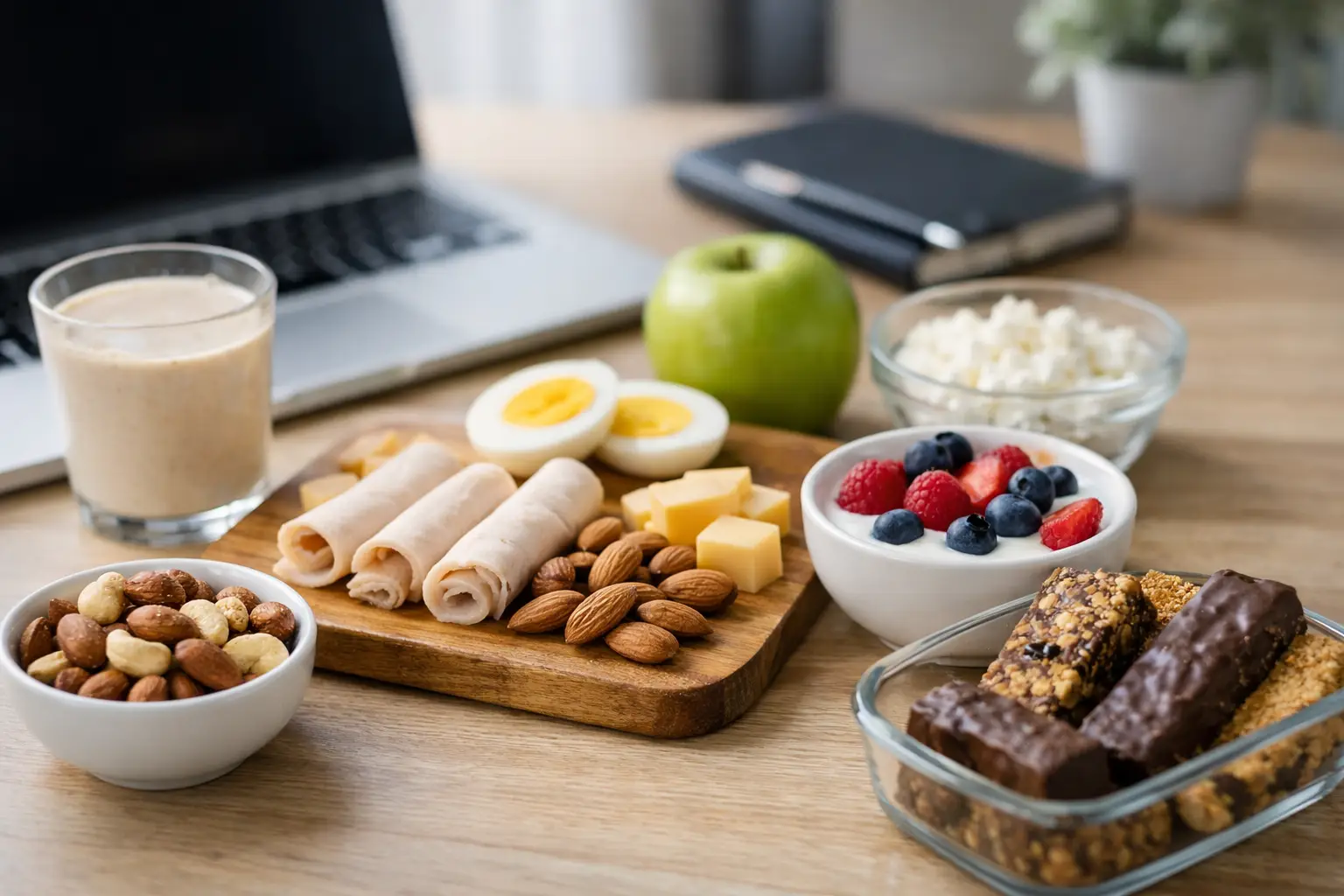
The most practical choice for most people is protein bars. They easily fit in a backpack, require no preparation, and help when your schedule falls apart. However, the differences between bars are significant. Some truly have plenty of protein and a decent enough composition, while others are more like a dessert with a “fitness” label. When choosing, look not only at total calories but also at protein, sugar, and satiety. If you’re hungry again an hour after a bar, it’s simply not right for you.
Protein puddings are also a strong option, especially if you have a fridge at your workplace. They suit those who want something to eat with a spoon rather than a dry snack between meetings. The upside is that such a snack often feels more like a normal mini meal, making it easier to manage appetite until lunch. The downside — it’s not always convenient to keep things cold, and for some people, sweeter flavors get boring quickly.
Protein shakes or ready-to-drink beverages work best when there’s almost no time. This is especially convenient after a workout before work or when your lunch break is short and you need a quick solution. On the other hand, a liquid snack doesn’t give everyone the same feeling of fullness as a bar or pudding. If you know you feel hunger strongly, a shake alone may not be enough.
If you want a simpler, less “sporty” solution, high-protein yogurts or cottage cheese-based snacks work great. They’re closer to regular food, so for many people they become a daily habit more easily. It’s just important to consider storage conditions and whether this choice is convenient for you at the office, in the car, or on a business trip.
How to choose a snack that helps, not just looks healthy
The first criterion is the amount of protein per serving. If a snack has only a token amount of protein, it won’t do its job. For most people, it’s worth looking for an option that delivers a tangible amount of protein and genuinely satisfies.
The second criterion is sugar content and the overall product profile. Sometimes the “protein” label hides a product with so much sugar that your energy spikes quickly and crashes just as fast. This doesn’t mean all sweeter snacks are bad. It’s simply worth understanding when you’re choosing a functional snack and when you’re choosing a dessert with protein.
The third criterion is digestive tolerance. Some bars or puddings contain a lot of sweeteners, fiber, or sugar alcohols. For some people this works great, while others feel bloating or heaviness after such a snack. If you know you have a more sensitive digestion, it’s better not to experiment before long meetings or trips.
The fourth criterion is convenience for your day. If you spend the whole day on the road, a product requiring refrigeration may not be practical. If you work in an office and have a drawer for snacks, bars or ready-to-drink beverages often win. The best choice is the one you’ll use regularly, not the one that looks perfect in theory.
When a protein snack is a good idea and when real food is better
Protein snacks at work work best between breakfast and lunch, during the post-lunch energy slump, or after a workout if a full meal is still far off. In these situations, they help you maintain your rhythm and prevent the day from sliding into random choices.
But there’s another side. If you’re constantly “snacking” because you don’t have a proper breakfast or keep skipping lunch, the problem isn’t the quality of the snacks. Then even the best protein snacks at work become a temporary band-aid. They work great as support, but not as the foundation of your entire diet.
So it’s worth looking at it soberly. For one person, a single bar after lunch will be the ideal solution; for another, a bigger breakfast works better and no additional snack will be needed. Your rhythm, the nature of your work, and your hunger signals matter more here than general advice.
Most common mistakes when choosing protein snacks
One of the most common mistakes is choosing based on a single number on the packaging. For example, you see a lot of protein and stop looking at anything else. But taste, satiety, composition, and tolerance determine whether a product becomes a useful habit. If you buy the “correct” option that you don’t like, it won’t stick around for long.
Another mistake is expecting a protein snack to automatically help with weight loss. It can help you control hunger better, but only when it fits with your overall daily routine. If the snack simply adds to an already chaotic diet, there may be no result.
The third mistake is not having a backup option. This is exactly where spontaneous choices from a vending machine or gas station are born. When you have at least one reliable protein snack in your bag, drawer, or car, decision-making becomes much easier.
How to create your own system for the work week
Instead of improvising every day, it’s useful to set up 2-3 reliable options for different situations. For example, keep one in a drawer for hunger emergencies, have another after a workout, and choose the third on days when you know lunch will be late. A system like this reduces chaos and helps you stay consistent.
If you’re just starting out, you don’t need to find the perfect solution. First, observe when you most often get hungry, what type of snack keeps you full the longest, and what makes you feel your best. Some people want a crunchy and quick solution; others need a creamy, sweeter option that psychologically “shuts down” hunger more effectively.
That’s exactly why it’s worth choosing by function, not by trend. Your goal isn’t to eat “sporty for appearances.” Your goal is to work more steadily, feel better, and stick to your routine more easily.
Are protein snacks suitable for everyone?
In most cases — yes, but not equally. If you’re physically active, want to maintain muscle mass, or simply struggle to hit your daily protein intake, they can be very practical. If your diet is already well-structured and you don’t feel hungry between meals, an additional snack may simply be unnecessary.
Your goal matters too. Some people choose protein snacks for satiety, others for convenience, and still others for athletic goals. When you know what you want from a snack, choosing becomes much simpler. And if you need a clearer starting point, it’s worth relying on trusted, curated solutions rather than random products that just promise a lot.
In the StayStrong community, we see the same thing over and over — progress is most often built not by perfect plans, but by good, repeatable solutions. If you often run low on energy during workdays or get caught up in unnecessary snacking, start with one practical change. Sometimes one well-chosen protein snack helps far more than it seems at first glance.
A stronger day starts not with an ideal menu, but with the decision to prepare for that moment when hunger strikes off-schedule.